01 Frame
Welcome & frame
Why we're here, and today's promise. We set the tone as a conversation, not a presentation. Round-the-room intros: name, role, and one workflow you wish would disappear.
Direct conversation and hands-on work across nine blocks. No clock-watching — we move when the room is ready. Discussion never feels rushed; the worksheet blocks feel productive. Budget a full working day and let the material breathe.
Why we're here, and today's promise. We set the tone as a conversation, not a presentation. Round-the-room intros: name, role, and one workflow you wish would disappear.
We establish a shared vocabulary — the eight patterns of automation, from scripts to retrieval — then walk the five-stage method. Discussion: where do you already see each pattern in your operation?
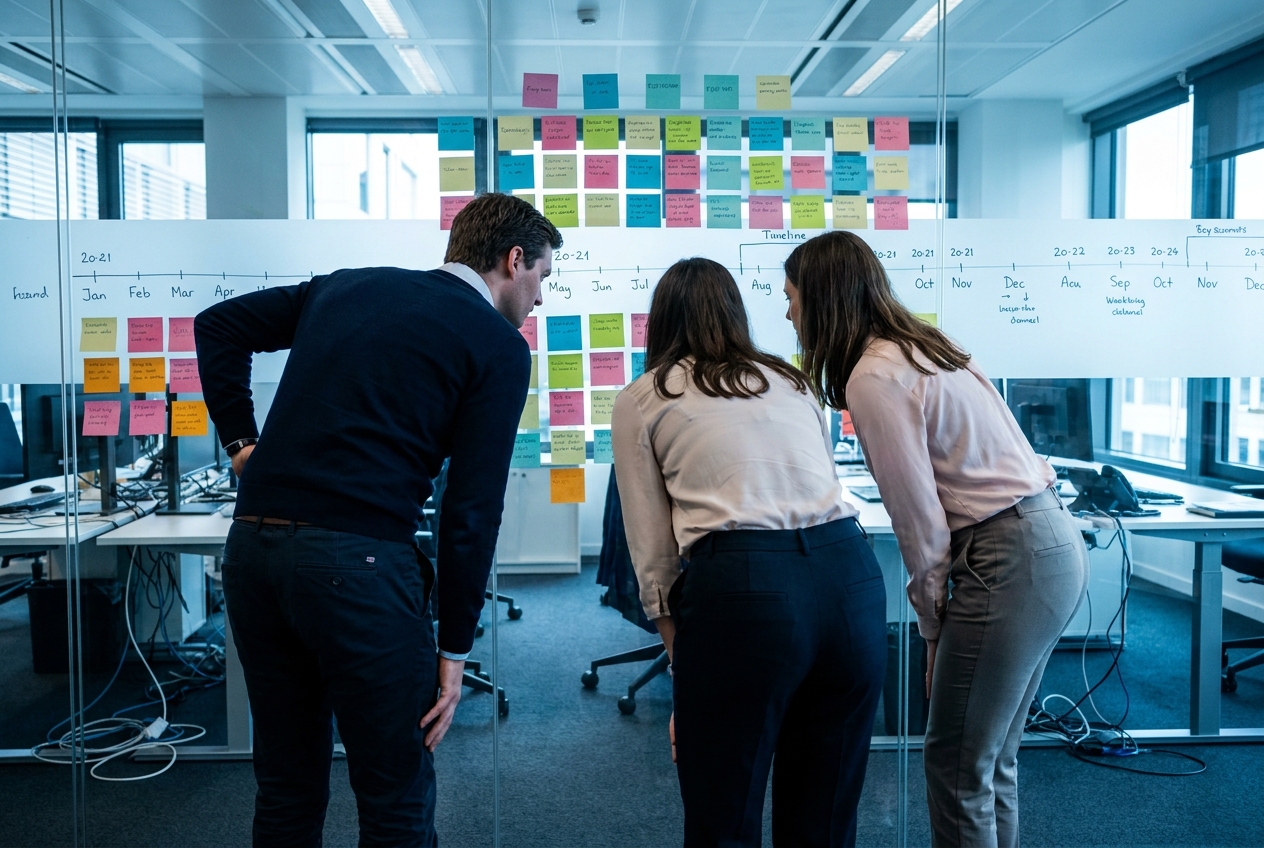
Surface the daily and weekly tedium and the frustrations — the widest possible inventory before we narrow. Individual worksheets first, then group share. Nominees go on the wall.
Coffee. Stretch. The side conversations are usually where the real wins surface.
Add the scheduled cadences — daily, weekly, monthly, quarterly. Then we pick three to five workflows and walk each one end-to-end as a group, on the whiteboard.
Each working group fills a Process Deep-Dive Canvas for one workflow: trigger, inputs, steps, outputs, systems, breakpoints. We float and stress-test every canvas.
Light agenda. We talk through the morning's surprises informally — the patterns are already starting to show.
We walk the pattern library and, for each mapped workflow, name the pattern — or the stack of patterns — it needs. First estimate of effort and value, annotated right on the canvases.
Score every nominee on ROI, confidence, speed, fit, and risk. Sort. Identify the quick-win shortlist. Round-table reconciliation — disagreements get flagged, not buried.
Pick the Day-1 pilot and sketch it. Build the 30/60/90 plan. Names go on the page — a working owner and an executive sponsor for every item.
Sign the commitments. Schedule the first working session. State the success metric out loud. A photo of the wall captures the artifact before anyone leaves.
Worksheets force individual thinking before group debate, and every commitment has a name on it. We don't water down either one.
Protect the worksheets — they're how the room thinks individually before groupthink kicks in.
Whiteboard the workflows we walk live. The canvases are for capture; the wall is for thinking.
Time-box ruthlessly. If a discussion runs long, it goes on the “next session” list and we move.
The exec sponsor is accountable in real time — they assign owners before they leave the room.
The metric is a number, not a sentiment. “Faster” is not a metric. “Under 24-hour resolution” is.
If energy drops after lunch, we stand up and move to the wall. The matching block needs heat.
Map the operation, not the org chart. We chase how the work actually flows — including the steps no process doc mentions — before naming a single solution.
We work the friction with the room, never dictate it. The people who own the work help design the fix — that's what makes it stick.
The session is bracketed by prep and follow-through. The artifacts are the point — and they don't sit on the wall after you leave.
We'll propose a date, send the pre-read and worksheets, and tailor the day to your business. One working session, and your leadership team walks out with a roadmap and a pilot.