AI from people who've actually run the business — and actually built the systems.
Most AI advice comes from consultants who've never carried a P&L or stood on your floor. We have. One day, on-site with your leadership team: we map the work your business really does, match each workflow to the AI pattern it actually needs, and hand you a ranked, costed roadmap and a Day-1 pilot. No buzzwords. No theater.
You leave with a ranked AI opportunity list, one scoped quick-win pilot, and a 30/60/90 plan with named owners. Anything less, we walk away.
Most leaders have seen the demo. Almost none have seen the system that runs the work.
The AI most people have touched — the assistant on a screen, the demo, the pilot that fizzled — is a thin slice of the capability. Useful, but the smallest, least valuable slice of what AI can do for an organization your size.
Production AI is something else entirely: models wired into your data, your tools, and your systems of record, running multi-step work under controls you set — without a person babysitting every keystroke. The gap between “we tried ChatGPT” and “we run agents against our ERP” is enormous. That gap is where the value lives. It's also where the risk hides.
We've sat through the hype cycle too, and this session is the antidote. You get a working understanding of what's real, run by operators who build these systems for a living, for the people who have to make the call.
“The demo isn't the system. We spend the day on the system behind it — and on how you'd put your own people to work in it.”
The chat box is one wire into a much larger machine.
What you've used is an interface. What does the work is a harness — the production engineering wrapped around a reasoning loop. Hover any node to see what we cover.
A system, not a chatbot
A harness is a closed-loop working system around the model. The loop reasons and acts; the harness makes it observable, testable, and safe to run in production. Hover any node — each is something we cover and build.
A five-stage loop that turns observed friction into a ranked portfolio.
Most AI roadmaps fail the same way: a list of interesting projects with no way to choose which one matters. Ours is fast enough to do in a day, rigorous enough to defend to the CFO.
- 1 Discover
What do you repeat? What frustrates you? What runs on a clock?
A wide inventory of named workflows — daily, weekly, monthly.
- 2 Map
How does this work actually happen — workarounds and all?
An end-to-end canvas per workflow: trigger, inputs, steps, systems, breakpoints.
- 3 Classify
What shape is this problem — rule, data, integration, or judgment?
Each workflow read for its shape before anyone reaches for a solution.
- 4 Match
Which of the eight patterns does this need — and how do they stack?
A pattern-matched proposal per workflow, with rough effort and value.
- 5 Score & Commit
What ships first? Who owns it? How do we know it worked?
A ranked portfolio and a 30/60/90 plan with names on it.
Four levers — pick the ones that move your P&L.
Every workflow we map gets tagged to one of these before it enters the roadmap. If it doesn't move one of them, it doesn't make the list.
Hours removed. Deterministic busywork automated; people reclaim their calendar for higher-leverage work.
Defect rate down. Consistency replaces tribal knowledge; quality work stops living in side spreadsheets.
Tacit expertise captured. The know-how in your people's heads becomes a queryable system — it doesn't walk out the door.
Decision cycles compressed. Schedulers, buyers, and planners decide in minutes, not at the end of the week.
Built for the people who decide.
This isn't a developer workshop. It's pitched at the altitude leaders actually operate at — strategy, budget, risk, and people — with enough depth that the decisions you make afterward are the right ones.
CEO / President
Where AI moves the P&L — and where it's theater you should skip.
COO / Operations
Which workflows are worth automating first, and what it takes to run them.
CFO
The real cost of AI, how to measure ROI, and how to govern spend before it gets away from you.
CIO / CTO
Architecture, build-versus-buy calls, and exactly what your team can own.
Department & function leaders
A pilot you can stand up in your unit inside 90 days — with a way to tell if it worked.
The room, together
One shared vocabulary, so the next budget conversation isn't three people talking past each other.
A plan you can act on Monday.
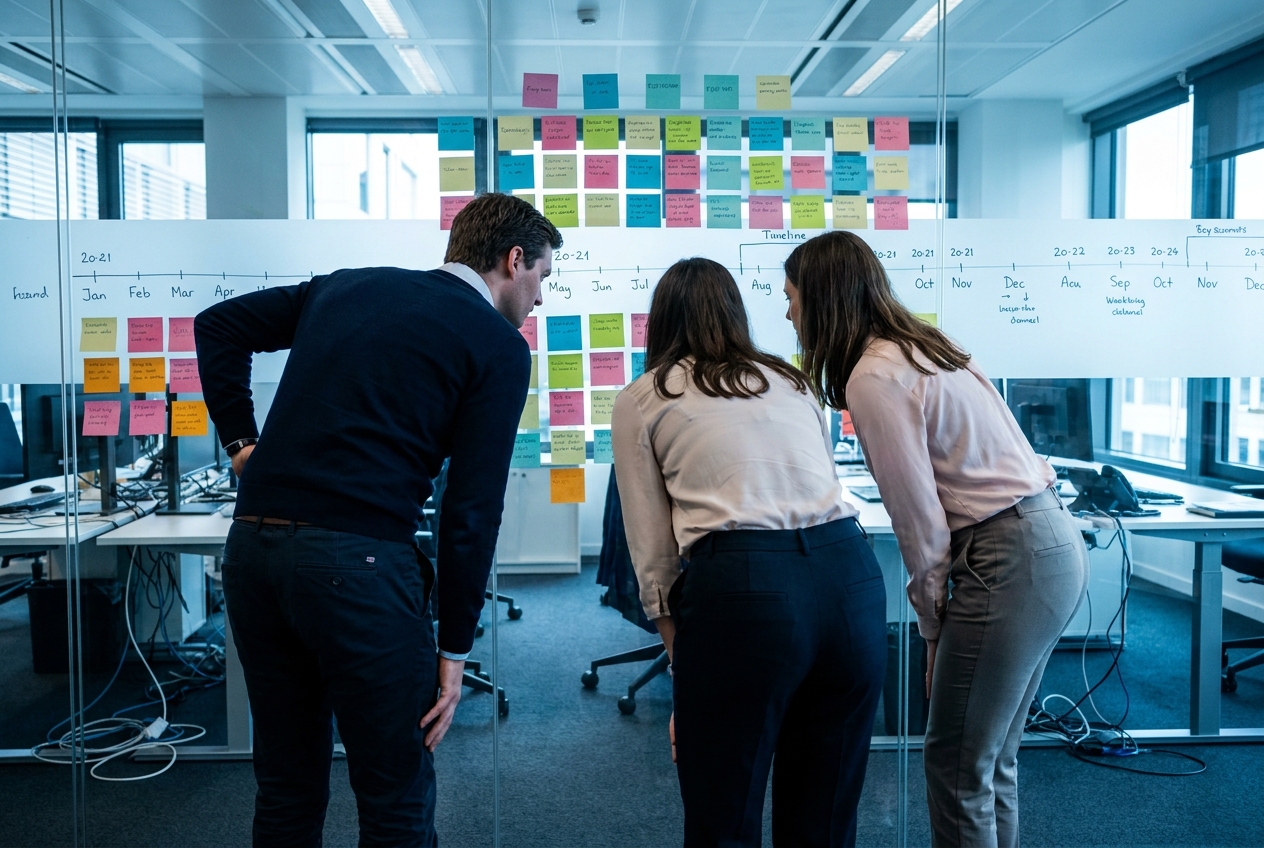
Most executive AI briefings leave you informed and stuck. This one ends with artifacts your team can act on — because the last block is spent building them, in the room, with you.
A prioritized opportunity list
Every candidate workflow in your business, scored on ROI, confidence, speed, fit, and risk — then ranked. You'll know what's worth doing and in what order.
One quick-win pilot, fully scoped
We pick the Day-1 win together and scope it end to end — so something is moving before the week is out, not stuck in committee.
A 30/60/90 roadmap
A sequenced plan with a named working owner and an executive sponsor on each item — a commitment your team can execute.
A measurement plan per opportunity
For each item: the metric that proves it worked, as a number. If we can't measure it, we don't ship it — and you don't fund it.
Build-versus-buy calls
For each opportunity, a clear read on whether to buy a platform, build it, or partner — with honest cost ranges grounded in what these builds actually run.
The honest “not yet” list
The things that sound exciting but aren't ready for your environment — and exactly what would have to change before they are.
We facilitate this because we build it — on-site.
The people in the room aren't only AI engineers. They're operators and systems people who design the GPU clusters and validate the inference stacks — and who have also sat inside real operations long enough to know how a business actually runs before they touch it. CTG National has delivered over $2B in solutions since 2017, and the AI lab is where we build, validate, and deploy the systems we'll map your work against.
We do that work in your environment, not from a distance. We interview, follow the process, sit in the seat, and keep asking why until we genuinely understand where the friction lives — then we plan and build alongside your team, not over their heads. We don't push a system onto your people; we work the problem with them. The roadmap session is day one of that.
And we don't just point AI at the process you run today. Paving an inefficient workflow only makes it expensive to run, token for token — the bigger win is rebuilding the operation so the system runs lean. That's an operations call as much as an AI one. When it's hard, we'll tell you; when it's easier than the market makes it sound, same; and when AI isn't the answer, we say so.
Get your leadership team on the same page.
Tell us your industry and who'll be in the room. We'll tailor the demos and the roadmap workshop to your business, and send back a proposed date. One day, and you leave with a plan in hand.